Mia Wolf · 18 October 2026
Exploring Efficiency Gains in Enterprise Data Flows Through Targeted Middleware Deployments
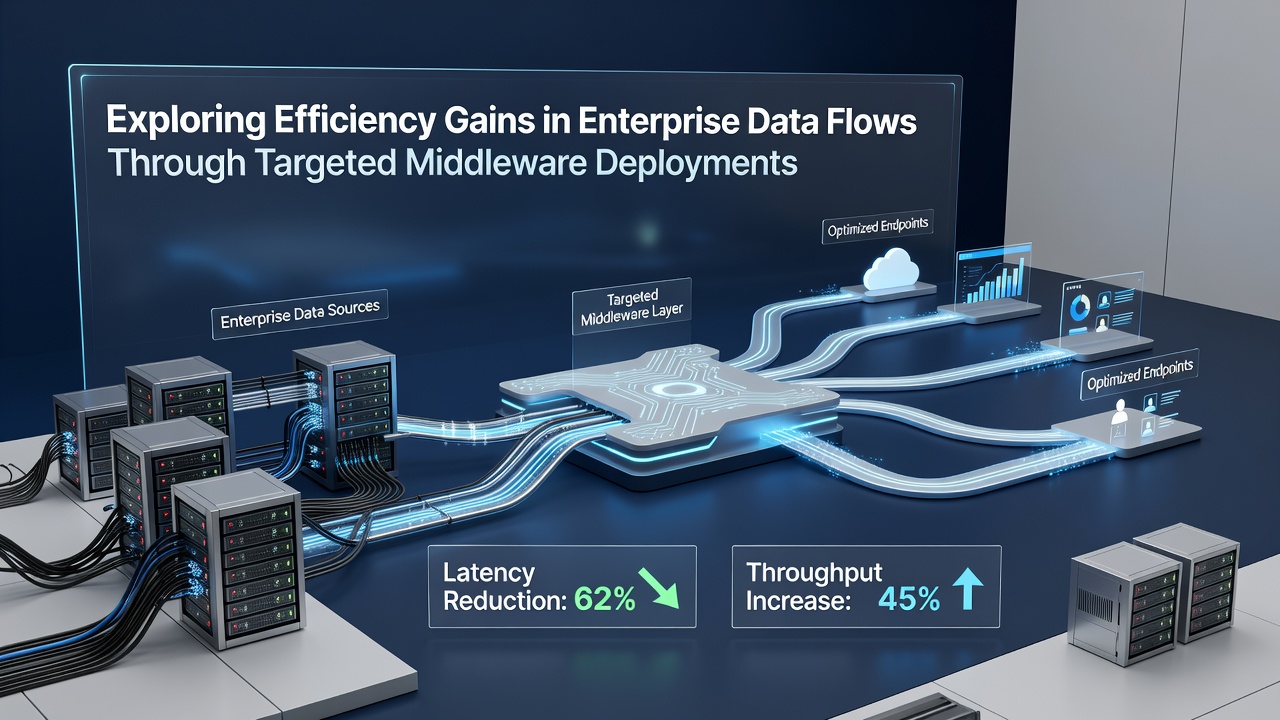
Enterprise data flows often encounter bottlenecks when systems operate in isolation, yet targeted middleware deployments have emerged as a practical approach to streamline these processes, researchers have observed across multiple industries. Middleware acts as an intermediary layer that handles communication, data transformation, and routing between applications, databases, and external services, allowing organizations to manage complex integrations without rewriting core systems. Studies from various sectors indicate that such deployments can reduce latency in data transfers by coordinating asynchronous messaging and caching mechanisms, which in turn supports higher throughput during peak operational periods.
Core Components of Middleware for Data Optimization
Message-oriented middleware, enterprise service buses, and API gateways represent key categories that address different aspects of data movement, according to analyses from technology research groups. These tools enable protocol translation so legacy mainframes can exchange information with cloud-based analytics platforms, while also providing monitoring features that track data volume and error rates in real time. Observers note that when deployments focus on high-traffic pathways first, organizations achieve measurable improvements in processing speeds, as the middleware offloads repetitive tasks like format conversion and validation from primary applications.
Data from integration projects shows that selective placement of middleware at network edges or between specific service clusters yields better results than blanket implementations across entire infrastructures. This targeted strategy minimizes overhead while maximizing impact on critical flows, such as those supporting inventory updates or customer transaction processing. Experts have documented cases where companies reduced duplicate data entries by routing information through centralized transformation hubs, thereby cutting storage costs and improving consistency across distributed environments.
Measured Outcomes in Large-Scale Environments
Performance metrics compiled by industry monitoring services reveal that enterprises adopting middleware for data orchestration often experience throughput increases ranging from twenty to forty percent in targeted segments, depending on the initial architecture. Reduced manual intervention in data pipelines contributes to these gains, as automated routing and retry logic handle transient failures without halting broader operations. One analysis of manufacturing networks found that middleware layers synchronized supply chain data more effectively, allowing real-time adjustments that previously required separate batch jobs completed overnight.

Security and compliance requirements also benefit when middleware incorporates encryption and access controls at the integration point rather than at every endpoint. Reports from regulatory bodies in the European Union highlight how standardized middleware configurations help maintain audit trails for cross-border data exchanges, while similar frameworks in Canada emphasize interoperability standards that support similar efficiency objectives. These approaches demonstrate that middleware can serve dual purposes of performance enhancement and regulatory alignment without introducing separate overhead layers.
Implementation Patterns and Resource Allocation
Deployment strategies that prioritize pilot testing on non-critical data streams allow teams to refine configurations before scaling, a pattern documented in several enterprise case reviews. Resource allocation tends to focus on monitoring tools that provide visibility into queue depths and processing times, enabling proactive adjustments as data volumes fluctuate. Organizations that integrate middleware with existing orchestration platforms like Kubernetes report smoother scaling during seasonal spikes, since containerized middleware instances can spin up alongside demand without extensive reconfiguration.
Training requirements for operations staff center on understanding middleware-specific logging and tuning parameters, which differ from traditional application development skills. Data indicates that cross-functional teams combining network engineers with data architects achieve faster stabilization periods following initial rollout, as they address both connectivity and semantic mapping challenges concurrently. External references such as those available through the National Institute of Standards and Technology outline reference architectures that guide these decisions in structured environments.
Comparative Analysis Across Sectors
Financial services firms have applied middleware to consolidate transaction feeds from multiple trading platforms, resulting in consolidated reporting cycles that previously spanned several hours now completing within minutes, according to sector-specific benchmarks. Healthcare systems, meanwhile, use similar tools to route patient records between electronic health record vendors while preserving privacy controls embedded in the middleware rules. Australian government technology assessments note parallel improvements in public sector data sharing initiatives where middleware reduced reconciliation errors between agency databases.
Energy utilities represent another area where targeted middleware supports integration of sensor data from remote sites with central control systems, facilitating quicker response to grid anomalies. These examples illustrate that efficiency gains correlate strongly with the precision of deployment rather than the sheer volume of middleware instances introduced. Research from academic institutions in Asia further supports the observation that hybrid cloud setups derive particular advantage from middleware that bridges on-premises and cloud-native data stores without requiring full migration upfront.
Conclusion
Targeted middleware deployments continue to demonstrate capacity for enhancing enterprise data flows through focused integration points that address latency, consistency, and scalability simultaneously. Evidence from multiple geographic regions and industry verticals confirms that careful selection of deployment locations and component types produces quantifiable improvements in processing efficiency. As data volumes grow and system landscapes diversify, organizations maintain these advantages by aligning middleware capabilities with specific flow characteristics rather than pursuing uniform solutions across all connections.